A football manager game (soccer, if you're in the US) is one where the computer plays the matches and you run the club. At Raptware we're designing one, and before writing a line of code we did our homework: how do existing games simulate a match, what works and what doesn't. Here's what we found and the strategy we chose.
The idea: the club is the game
In our design you don't control players on the pitch. Matches play themselves. Your job is the club: put each player on a training regime, watch them level up and build a team that wins without you. It's a loop much like a farming game, where you look after something that grows over time.
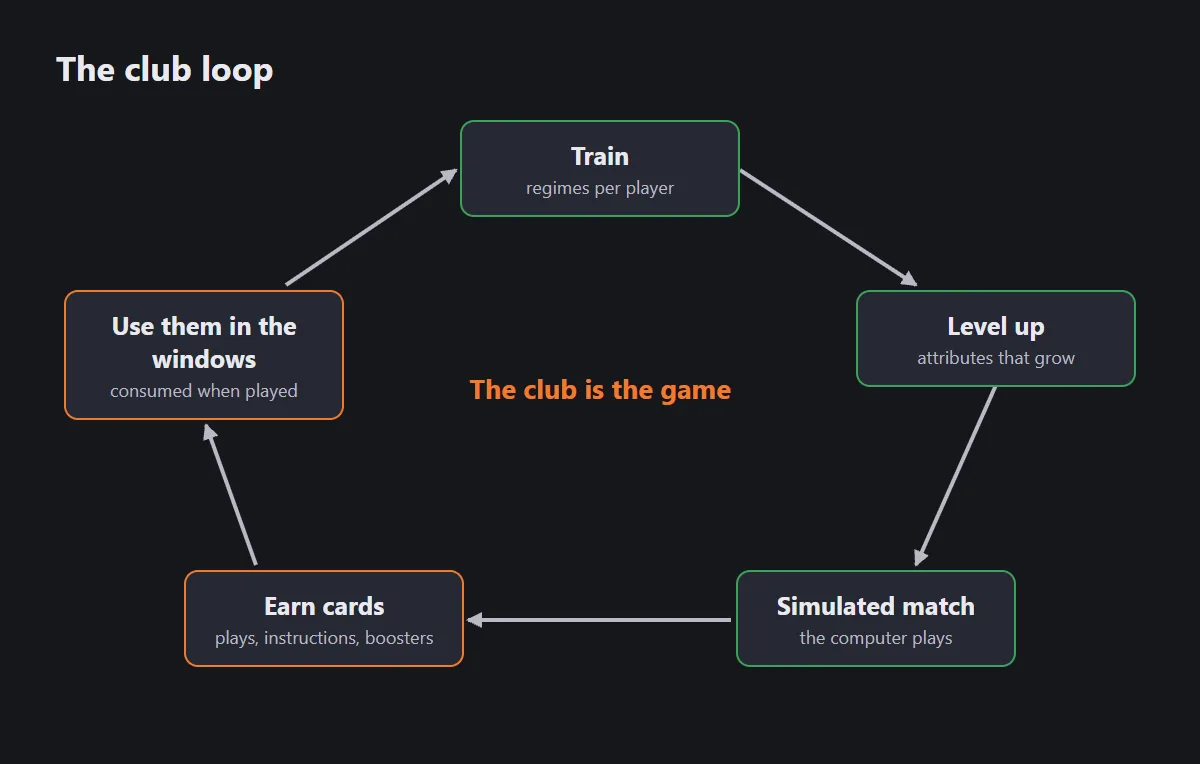
What makes it different are the cards: plays, instructions and boosters you earn by playing, and that are spent when you use them.
The match: 90 minutes in 5, and four windows
The match is simulated in "real time," but compressed: the 90 minutes go by in 5 real minutes at most. Nobody wants to sit through a full match of something they don't control.
Before it starts there's the pre-match: you pick the players, the line-up, the tactics and how aggressive the team comes out. During the match there are three breaks, and we took them from real football: the 2026 World Cup introduced mandatory drinks breaks at the 22nd minute of each half (as FIFA announced), so a match already feels like four quarters. Our windows are those two breaks and half time.
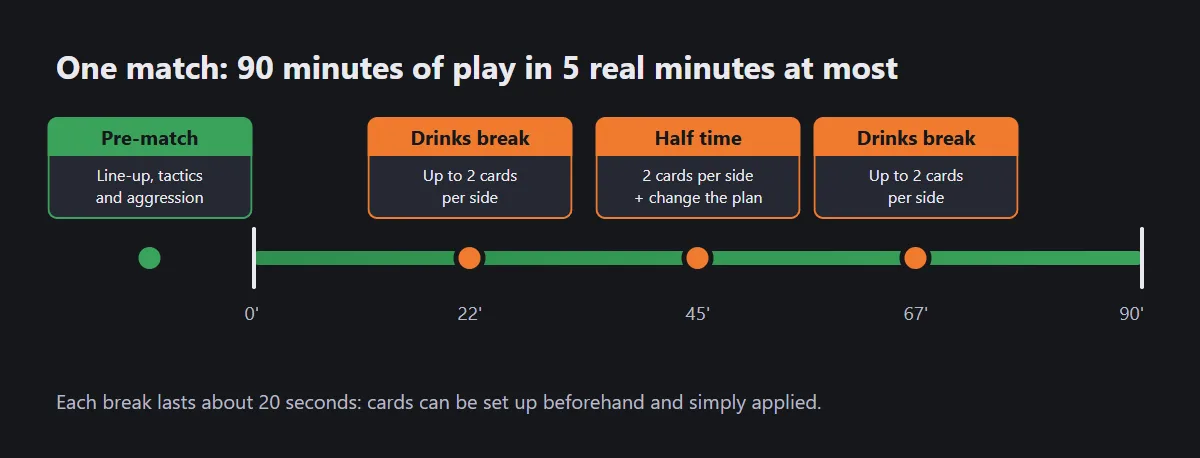
- In each break, each side can play up to two cards from their deck. Whatever you play changes the simulation from that moment on.
- Each break lasts about 20 seconds. It's not time to think from scratch: you can set your cards up beforehand and simply apply them in the break.
- The pre-match plan can be changed at half time. You can prepare it any time during the match, but it only kicks in at half time. With a booster, you can make it kick in at one of the drinks breaks instead.
That way, watching a match stops being just waiting for the score: there are four decision points, and the other side decides too.
Four ways to simulate a match
This is what we found about how it's done today:
- Score only. Statistical models that estimate how many goals each team scores from its attack and defense. They come from academic research (Maher, 1982; Dixon and Coles, 1997: Maher, Dixon and Coles). Extremely cheap, but they only give the final score: there's no 20th minute where a card could change anything.
- By sectors. Midfield decides who has the ball, and each attack is resolved by comparing one sector's attack with the other side's defense. It's the style of text managers like Hattrick. Easy to explain: "you lost the midfield, so you got fewer chances."
- Minute by minute. The sector idea, repeated every minute, with events: possession, chance, shot, goal. It gives a full timeline for very little computation.
- Player by player. Each footballer decides what to do based on their attributes. Football Manager, for example, has players and officials make a decision every quarter of a second (as its developers explain). It's the most realistic, but also the most expensive to compute and the hardest to balance. Projects like Google Research Football go as far as full physics.
The one we picked: minute by minute, with sectors
We went with the third, built on top of the second. Every simulated minute goes through four steps, and each step has a place where a card can act:
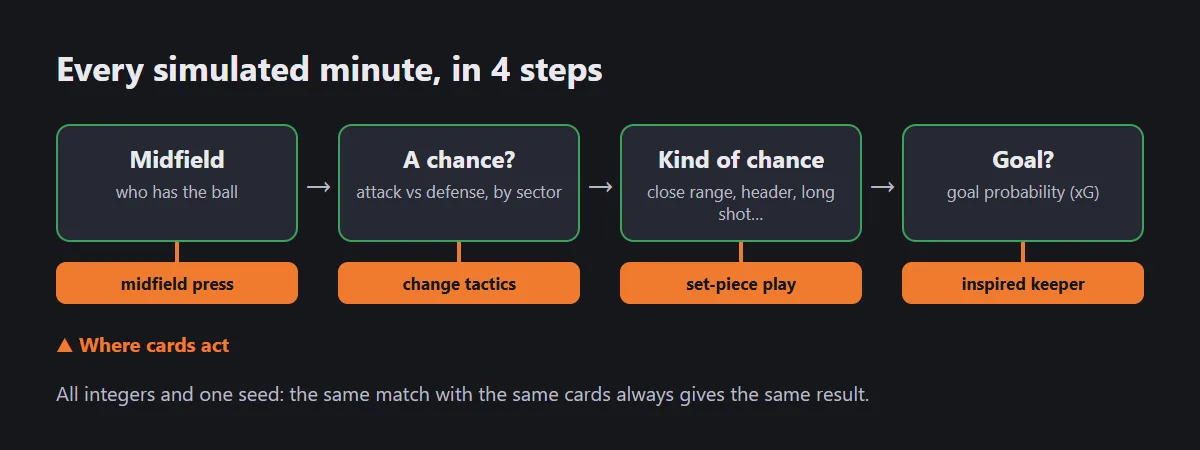
To decide whether a chance becomes a goal we use the idea of expected goals (xG): each kind of chance has a probability of being a goal, the way real football analysis uses it (a review of the topic). A close-range shot is worth more than a long one, and a good keeper lowers that probability.
Why this one and not the most realistic? Because it gives us the three things we need: a timeline where the windows fit, light computation that can run on a modest server, and clear levers for the cards. A "midfield press" card has an obvious place to act; in a player-by-player simulation, its effect would get lost among thousands of decisions.
Making cards matter without luck taking over
We've already seen this design's biggest risk in another game. Nutmeg!, a card-based football manager, was praised for the idea and criticized for too much randomness. If a card decides the match, training the club stops mattering. So these are our rules:
- Cards move probabilities, not results. A card can make a chance more likely, but it doesn't create a goal out of nothing.
- The club is the foundation. A well-trained team wins more often, with or without cards.
- Both sides play. Since the rival has cards too, there's always an answer.
- They're consumables. Spending a card is a decision, because afterwards it's gone.
Fair and repeatable
Since both sides play cards, the match is simulated on the server, not on anyone's phone. And we make it deterministic: with the same seed and the same cards, the match always comes out the same. It's a well-known technique in online games (here is a good explanation), and it lets us replay any match to check a complaint or make sure nothing broke.
What's next
This is the starting point of the design, not the finished game. The numbers, the balance and a lot of testing are still ahead, and we'll keep telling you about them here. Meanwhile, you can play our free online games.
Which card would you want in your deck at the last break, in the 67th minute, one goal down? Write it in the comments; the best ideas might end up in the deck.
Comments
Sign in with your Raptware account to leave a comment.
Personal details
Sorry, this site is made for kids and adults alike, so we can't allow sharing personal details. Thank you for understanding, and for your comments!