Reversi strategy fits in one idea: corners can never be flipped, and whoever controls them almost always wins. The second idea surprises every beginner: flipping lots of discs early does not help. In fact, it is usually the fastest way to lose. Here we explain both, and what follows from them.
The rules in thirty seconds
Reversi is played on an 8 by 8 board that starts with four discs in the center, two of each color. On your turn you place a disc so that it traps, in a straight line, one or more of your opponent's discs between the new one and another of yours; every trapped disc turns to your color. If you have no legal move, you pass. Whoever has more discs when nobody can move wins.
Why corners are worth so much
To flip a disc you have to trap it from both sides, and a disc in a corner has no "other side": no move can ever trap it. It is a stable disc, yours until the end of the game.
And it does not stay alone. From a corner you can fill the edges next to it with discs that cannot be flipped either, because they lean on the corner. An early corner often turns into a whole wall of safe discs.
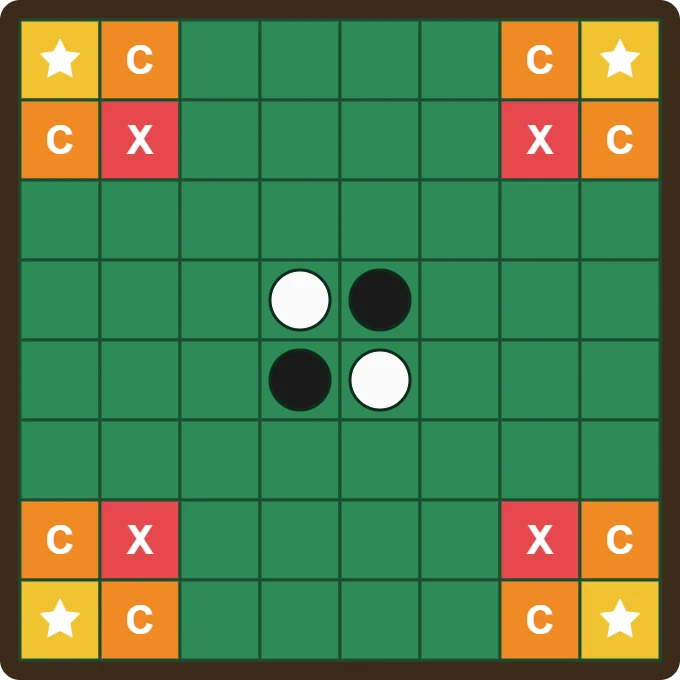
The squares that give corners away: X and C
If corners are what you want, the squares next to them are what take them from you:
- X-squares (red): the ones touching the corner diagonally. Placing a disc there while the corner is empty almost always opens the way for your opponent to take it. It is the most expensive mistake in the game.
- C-squares (orange): the ones touching the corner along the edge. They are less dangerous than X-squares, but they can also hand over the corner. Use them only when you are sure your opponent cannot take advantage.
The practical rule: while a corner is empty, do not play on its X-square, and think twice before playing on its C-squares. Better still, make your opponent be the one forced to play there.
Fewer discs early, more options
Here is the counterintuitive part. In the opening and the middle game, what matters is not how many discs you have, but how many moves you have. That is called mobility.
If you flip many discs, you fill the board with discs your opponent can use to trap theirs, and you give them more moves. If you keep few discs, grouped together, your opponent runs out of options, and sooner or later has to play where they do not want to: on an X or C-square.
Two tips that follow from this:
- Between two similar moves, pick the one that flips fewer discs.
- Avoid frontier discs, the ones touching empty squares: those are the ones your opponent can attack. Discs surrounded by other discs are safer.
Edges, carefully
Edges look safe because they can only be attacked along the edge itself. But a row of your discs on an edge, with a gap in it, can end up handing your opponent a move that flips the whole row and gives them the corner too. Before taking an edge, look at what moves it opens for your opponent on that same edge.
The endgame: now count discs
In the last moves everything changes: there is no future to think about, only the result. That is when flipping as many discs as you can pays off. One detail decides close games: when only a few empty regions remain, try to be the one who makes the last move in each, because the last move in a region cannot be answered.
Practice against the Animondos
The best way to learn all this is to play and lose a few corners. In Animondos' Reversi you face opponents with different styles, from Giovanna's clever tactics to Ethan's relentless logic, and you play right in your browser with nothing to download. If you like this kind of game, we also have more free online games with no download.
Try this in your next game: do not touch a single X-square, and see how many corners end up being yours.
Comments
Sign in with your Raptware account to leave a comment.
Personal details
Sorry, this site is made for kids and adults alike, so we can't allow sharing personal details. Thank you for understanding, and for your comments!