In Reversi, the player with more options wins, not the player with more discs. That is called mobility: how many legal moves you have on your turn. If you have plenty and your opponent has few, sooner or later they have to play where they don't want to, and that usually means handing you a corner.
In our previous post, how to win by taking the corners, we covered why corners decide games and mentioned mobility in passing. Here we explain it properly, with a real board example.
Count moves, not discs
In the middle of the game, the disc count lies. You can be ahead 30 to 10 and still lose, because those 30 discs give your opponent lots of places to play. The reverse works too: a few well-placed discs can leave them with nowhere to go.
The question to ask before every move is not "how many discs do I flip?" but "how many moves do I leave my opponent?" The fewer, the better.
An example: the quiet move versus the loud one
On this board it's Black's turn, with 16 possible moves. We marked two:
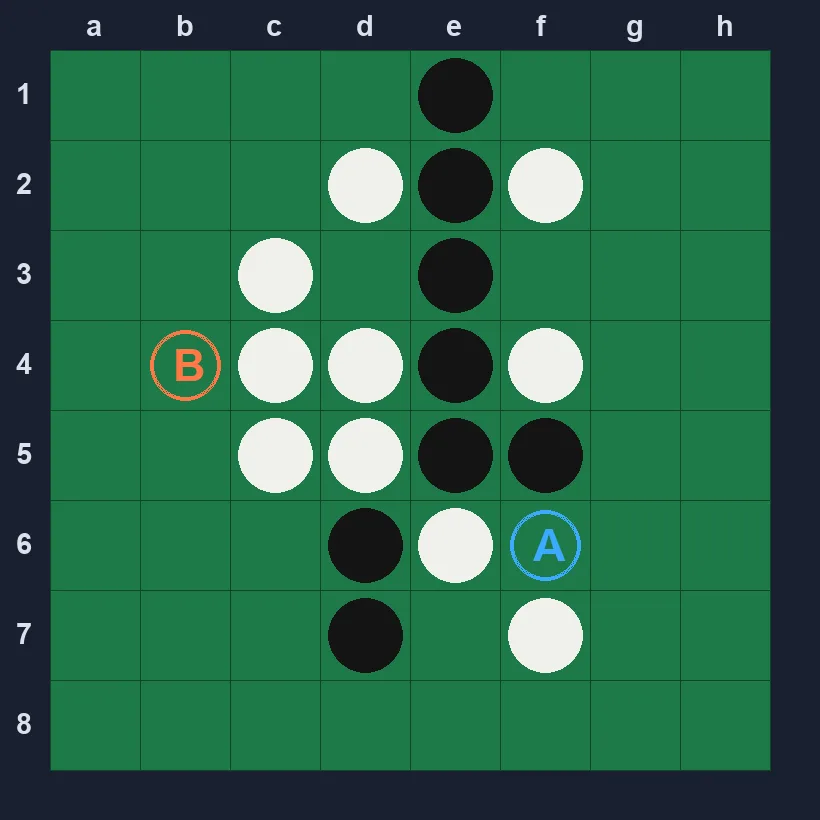
- A (f6) flips a single disc. After it, White has 6 moves.
- B (b4) flips five discs. Looks better, right? After it, White has 15 moves.
B looks generous on the scoreboard, but it opens the board: it leaves black discs exposed in every direction, and each one is another place where White can sandwich. A barely changes anything, and that is exactly why it's good. This kind of move is called a quiet move: it flips little and opens no doors for your opponent.
We counted the moves with a program, not by eye, so the example is exact.
Frontier discs: the ones that feed your opponent
Why does B open so much? Because of frontier discs: discs that touch at least one empty square. Your opponent can only play on empty squares next to your discs, so every frontier disc of yours is a potential move for them.
Interior discs, surrounded by other discs, give them nothing. That's why experienced players prefer moves that flip discs in the middle of a group and avoid moves that leave their discs poking out into empty space.
An easy rule to remember: play inward, not outward. Between two similar moves, pick the one that keeps your discs closer together.
Beware of walls
A wall is a long line of your discs facing an empty area. It feels solid, but it's the opposite: every disc in the wall offers your opponent a square to play on, and they can take their pick at leisure. If you notice you're building a wall of your color in front of open space, you're probably giving away free mobility.
Taking options away from your opponent
The other half of mobility is cutting down your opponent's. A few ideas:
- Leave their discs on the frontier. If their discs are the ones touching empty space, the moves are yours.
- Don't flip discs that are boxing them in. Sometimes flipping an opponent's disc solves a problem for them: it swaps their exposed discs for exposed discs of yours.
- Aim to leave them with bad moves. You don't need to leave them with no moves at all. It's enough if the few they have are X or C squares, the ones that give away corners.
When a player has no legal move, they pass and the other player moves twice in a row. Getting there in the middle of the game is usually a huge advantage.
At the end, discs do count
Mobility rules the opening and the middle game. In the last few moves there's no future left to protect, and that's when you should flip everything you can. The skill is knowing when to switch: while there are many empty squares, think in moves; when only a few are left, think in discs.
A drill for your next game
Before each move, take two or three candidates, count how many options each would leave your opponent, and pick the one that leaves the fewest. It's slow at first, but after a few games you start seeing it without counting.
You can practice against the Animondos in Animondos' Reversi, which runs in your browser with no download. And if you want more, here are our free online games.
How do you play: flip everything in sight, or have you gone over to the quiet side? Tell us in the comments if one of your games turned around after this, or ask about anything that wasn't clear.
Comments
Sign in with your Raptware account to leave a comment.
Personal details
Sorry, this site is made for kids and adults alike, so we can't allow sharing personal details. Thank you for understanding, and for your comments!